Why buy frozen seafood on an island
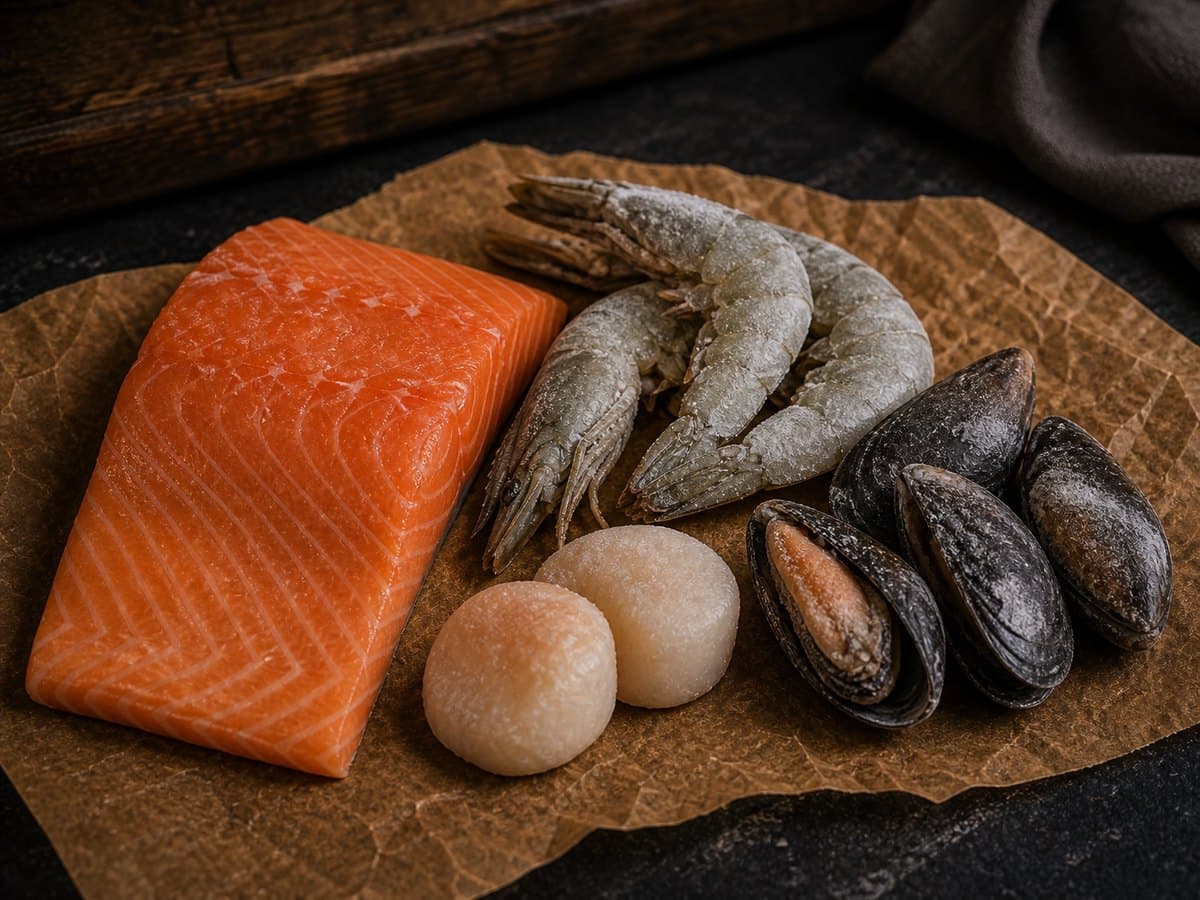
It is a fair question. Panglao is surrounded by water and the market has fish that was swimming this morning. For local species, buy local — we would say the same. What the island cannot give you is salmon, Chilean mussels or Hokkaido-style scallops, and for those the only honest options are frozen or nothing.
Seafood frozen at sea, within hours of the catch, is often in better condition than a fish that has sat on ice in the heat since dawn. Modern blast freezing takes the core below −18 °C fast enough that ice crystals stay small and cell walls stay intact. The problem, again, is never the freezing — it is the thawing and refreezing in between.
That is why we keep this range small. Every line here is one where the frozen version is genuinely good, rather than a compromise, and where there is no equivalent at the wet market down the road.
Salmon
Salmon fillet is priced by the kilo and cut to what you ask for. It is the most versatile fish in the case and the most frequently overcooked. Salmon is done at 50 to 52 °C in the centre — translucent, just set, still glossy. At 60 °C the white albumin squeezes out onto the surface and the texture turns chalky. That white seepage is the visible sign that you went too far.
The best home method is skin-side down in a moderately hot, lightly oiled pan, pressed flat for the first thirty seconds so the skin does not curl, then left alone for five or six minutes. The flesh turns opaque from the bottom up — when that opacity has climbed about three quarters of the way, flip for sixty seconds and take it off.
For the oven, 140 °C for fifteen to twenty minutes gives a far more even result than a hot oven and is much harder to get wrong. Slow-roasted salmon is the technique to use when guests are involved.
Salmon also cures beautifully at home. Equal parts salt and sugar, a handful of dill, twenty-four to thirty-six hours in the fridge under a weight, rinse and slice thin: gravlax, for a fraction of what smoked salmon costs.
Tuna, pompano, cream dory
Tuna belly is the fatty cut, and it is the one to buy if you are grilling. The fat protects it from the heat and bastes it as it cooks; belly is forgiving where loin is not. Tuna fillet in 500g portions is leaner — treat it like a steak, sear it hard and fast, and serve it rare in the middle. Tuna cooked through is dry and grey, and no sauce fixes it.
Pompano is the local favourite in this case, and rightly so: firm white flesh, moderate fat, and a shape that suits whole cooking. Slashed, stuffed with lemongrass and ginger and grilled over charcoal, it needs almost nothing else. Fifteen to twenty minutes for a whole fish, turned once.
Cream dory — basa fillet — is the mild, boneless, inexpensive option, sold in 1kg packs. It has very little flavour of its own, which is the point: it takes on whatever you put with it, it has no bones, and it is the fish to feed to children and to people who say they do not like fish. Pat it very dry before cooking, because it holds more water than the others.
Squid, mussels, scallops
Squid rings come in 500g and 1kg packs and obey the oldest rule in seafood: two minutes or thirty minutes, nothing in between. Under two minutes of fierce heat and it is tender. Past that it seizes and turns to rubber, and it only becomes tender again after half an hour of slow braising, once the collagen has broken down. Pick an end of that range and commit to it.
Chilean mussels come cooked and frozen, usually on the half shell, which makes them one of the easiest things in the shop. Thaw, top with garlic butter and breadcrumbs, and eight minutes under a hot grill produces something that looks like considerably more effort than it was.
Half-shell scallops in 500g packs want the same discipline as squid: a very hot, very dry pan, ninety seconds a side, and no crowding. Scallops release water, and a crowded pan steams them instead of browning them. Dry them thoroughly, cook in batches, and do not move them while the crust forms.
Thawing seafood without wrecking it
Overnight in the fridge, on a rack over a plate so the fish is not sitting in its own melt. This matters more for seafood than for meat: fish left in a pool of thaw water goes soft and picks up an off smell that is not spoilage but is not appetising either.
For a faster thaw, a sealed bag in cold water for thirty to sixty minutes. Never in warm water, never in the microwave, and never on the counter in this heat.
Cook seafood the day it thaws. Unlike beef, it does not improve with a day in the fridge, and the texture declines noticeably after twenty-four hours.
One exception worth knowing: fish destined for the pan is better cooked from a state of not-quite-fully-thawed, still firm at the very centre. It gives you a little more margin before the middle overcooks.
How much to buy, and what to ask us
For fish as a main course, count 180 to 220 grams of fillet per adult, or 350 to 400 grams of whole fish once you account for head, bones and tail. For squid and scallops as a starter, 100 grams a head is plenty; as a main, double it.
Salmon, tuna and pompano are priced by the kilo and cut to order, so ask for the portion size you actually want rather than buying a block and dividing it at home. A 200g portion cut square cooks far more evenly than a tapering tail piece of the same weight.
Stock here moves faster and less predictably than in the rest of the shop — a delivery arrives, and the salmon is gone in three days. The product list on this page shows what the counter holds right now, refreshed from the till, but for anything specific it is worth a message on WhatsApp before you drive out to Bolod.