Why we cut from the block
Cheese is alive in a way that most food in a shop is not. Even a hard, aged cheese continues to change: moisture leaves, fat migrates, and the flavour concentrates. Cutting exposes a new surface to air, and from that moment the clock runs faster.
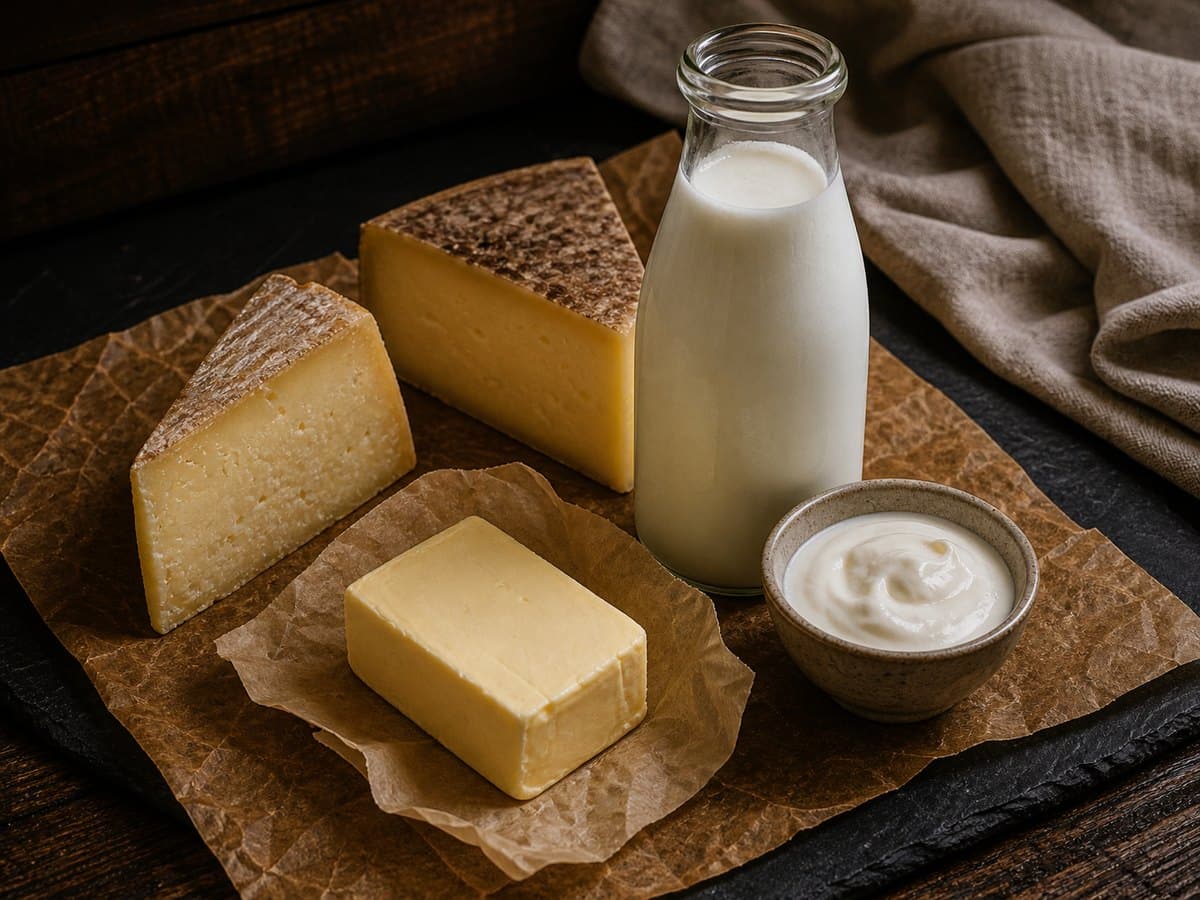
A pre-cut, plastic-wrapped wedge that has been sitting in a chiller for three weeks has spent three weeks drying and sweating inside that plastic. Cutting from a whole block when you ask means the face you take home was made a minute ago. This matters most for the semi-hard cheeses — Emmenthaler, cheddar, Gouda — where the difference in the first week is obvious.
It also means you can buy what you need. Two hundred grams of Grana Padano for a week of pasta is a perfectly reasonable order, and so is a kilo of cheddar before a party. Nothing here forces you into a pack size that does not suit you.
The hard and semi-hard cheeses
Emmenthaler is the Swiss cheese with the holes, and its flavour is far more interesting than its reputation suggests: nutty, slightly sweet, with a fruitiness that grows as it ages. It melts cleanly without splitting, which makes it the best cheese here for a gratin, a fondue or a croque monsieur.
Grana Padano is the hard Italian grating cheese, aged and crystalline, closely related to Parmigiano Reggiano but younger, milder and considerably less expensive. Those crunchy white specks in a well-aged piece are tyrosine crystals, and they are a sign of proper ageing rather than a fault. Grate it fresh — pre-grated cheese is mostly anti-caking agent and disappointment — and keep the rind to drop into soup.
Gran Amici is a firm, mild table cheese: the one to put on a board for people who do not want to be challenged, and the one children reliably eat.
Our cheddars come as white and red. The colour difference is annatto, a natural colouring, and not a flavour difference — a white and a red cheddar of the same age taste the same. Both are cut from the block by the kilo. The red cheddar at ₱1,120 is the everyday one; use it for melting, for sandwiches, for anything where cheddar is doing the work rather than being admired.
Fresh, soft and blue
Mozzarella comes two ways here, and they are different products. The block mozzarella, cut by the kilo, is the low-moisture kind: firmer, saltier, and the correct choice for pizza, because it browns and stretches rather than flooding the base with water. Mozzarella in brine, in 100g packs, is the fresh kind — milky, delicate, and meant to be eaten cold with tomato and oil, never baked.
Danish blue from Castello is the assertive one: salty, sharp, creamy. Blue cheese is best taken out of the fridge a full hour before eating, which is true of every cheese here but most obviously true of blue — cold flattens it, and warmth brings back the aroma it is bought for.
Cheddar burger slices are exactly what they say: processed for melting, and unapologetic about it. A proper aged cheddar splits and goes oily on a burger. These do not, because they are designed not to, and on a burger that is the correct engineering.
Keeping cheese alive at home
Cling film is the most common thing people do wrong. Cheese needs to breathe a little, and wrapping it airtight in plastic traps moisture against the surface, which is how you get a slimy face and an ammonia smell. Wrap it in baking paper or waxed paper first, then loosely in foil or a box.
Store it in the warmest part of the fridge, not the coldest — the vegetable drawer is usually right, around 8 °C. Near-freezing temperatures make hard cheese crumbly and kill the flavour of soft cheese entirely.
Bring cheese to room temperature before eating, and in this climate that takes twenty minutes rather than an hour. Cold cheese tastes of very little; the fats need to soften for the aroma to release. The one exception is anything you are about to grate, which is easier straight from the fridge.
Hard cheeses can be frozen if you are going to cook with them, and should not be if you plan to eat them as they are — freezing breaks the texture into crumbs. Mould on a hard cheese can be cut away with a centimetre of margin and the rest eaten; mould on a soft or fresh cheese means the whole piece goes.
The dairy shelf
Raw milk comes from cow, carabao and goat. Carabao milk is the richest of the three — noticeably higher in fat and solids than cow's milk, which is why it makes such good cheese and such thick yoghurt. Goat's milk is tangier and easier on people who struggle with cow's milk. Raw milk is exactly what it says: unpasteurised, from a local supplier, and it should be kept cold and used quickly.
Yoghurt comes as plain, Greek and homemade, in 500g tubs, alongside kefir. Kefir is the fermented one with the wider culture range and the thinner, drinkable texture — slightly fizzy, slightly sour, and an acquired taste that tends to stick once acquired.
Arla unsalted butter in 200g blocks is the baking butter: unsalted, so you control the seasoning, and with the fat content that European recipes assume. Ice cream — pints, plus goat-milk and dragon-fruit cups — is made locally and moves quickly.
Everything on the dairy shelf is dated and rotated, but it is also the fastest-moving part of the shop. The list on this page reads from the till, so what it shows is what is in the chiller now. For raw milk in particular, a message before you set off saves a wasted trip.
Buying for a board or for a week
For a cheese board, count 80 to 100 grams per person across three to five cheeses, and aim for contrast rather than quantity: something hard and aged, something soft, something blue, and one mild one for the people who are suspicious of the other three.
For a household week, 200 to 300 grams of a cutting cheese and a block of something for melting covers most cooking. Grana Padano is the exception — 150 grams lasts a surprisingly long time, because you use it in grams rather than slices.
Some of our own-label cheeses are bought from whichever supplier has the right product that month, so the shop's name is on them rather than a brand that might change between visits. The cheese is the same quality either way; we would rather not promise you a brand we cannot guarantee next week.