What makes a sausage worth buying
A sausage is a very short list of ingredients — meat, fat, salt, spice, a casing — which is exactly why the differences between a good one and a cheap one are so obvious. There is nowhere to hide. Cheap sausage stretches the meat with starch, water and phosphates, which is why it shrinks in the pan and leaves a grey puddle. A properly made one renders a little fat, browns, and comes out roughly the size it went in.
The fat ratio is the number that matters most. Around 25 to 30 per cent fat is where a fresh sausage stops being dry and starts being juicy; below twenty it eats like a meatball, above forty it turns greasy. That ratio is why sausage is never a lean food and should not pretend to be — the fat carries the spice, keeps the meat tender through the heat, and is the reason a bratwurst tastes like a bratwurst rather than like minced pork.
The other thing to look for is the grind and the bind. A coarse grind with visible grain — a Nürnberger, a Polish, a Cumberland — eats meaty and loose. A fine emulsion — a Frankfurter, a Wienerli, a white sausage — should be springy and smooth, almost bouncy, with no grittiness at all. Both are correct; they are simply different crafts, and a sausage that cannot decide which it is usually got there by accident.
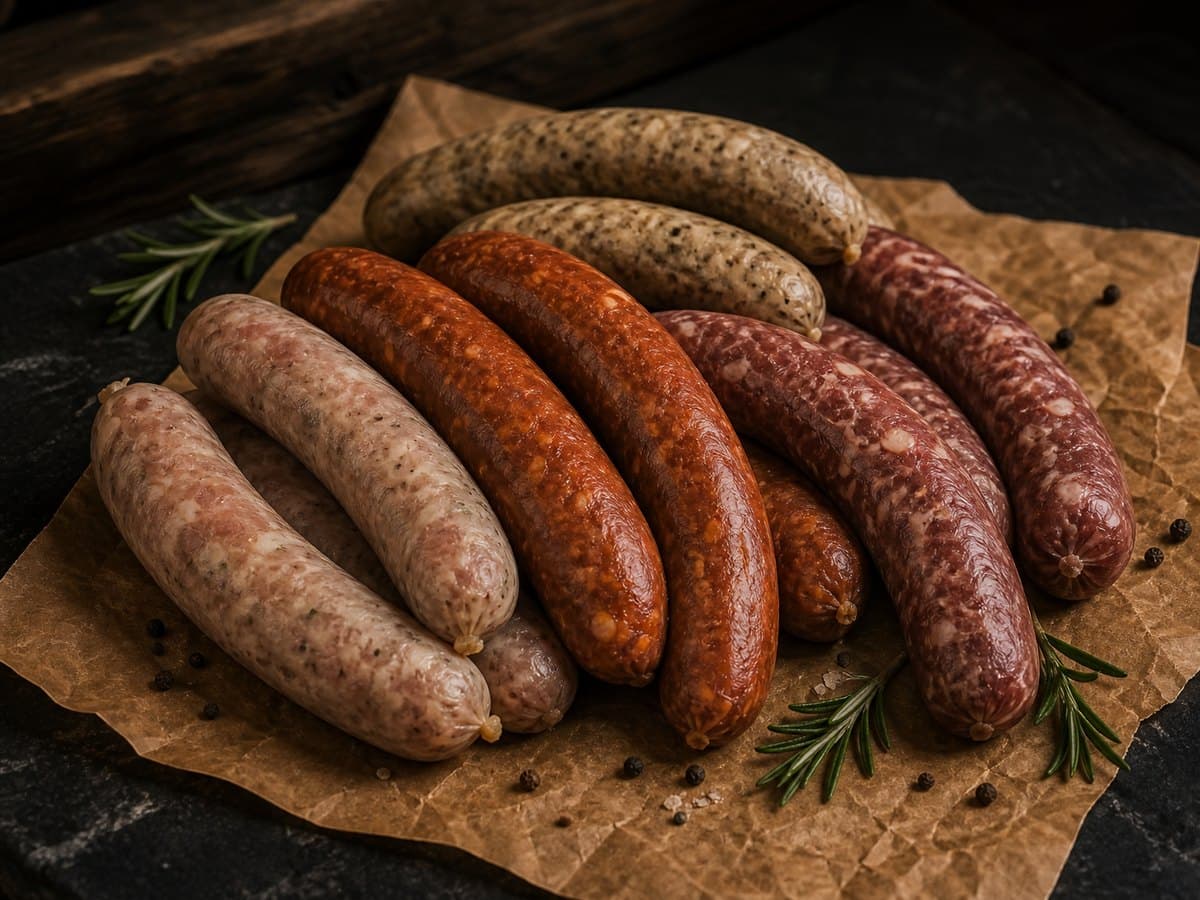
The German counter: bratwurst, Nürnberger, Weisswurst
Bratwurst is the broadest family and the least helpful name: it means, roughly, frying sausage. What you actually want to know is which region it comes from. Our Thüringer is the long, coarse, marjoram-forward one — marjoram is the giveaway spice, along with caraway and a little garlic — and it is the sausage most Germans picture when the word is said. The classic bratwurst beside it is milder, finer, and the safer choice for children and for anyone who does not want herbs leading.
Nürnberger are the small ones, barely the length of a finger, and they exist at that size for a reason: more surface area per bite means more crust. They are traditionally eaten three or six to a plate, or in a bread roll as Drei im Weggla. The seasoning is marjoram again, but lighter, and the grind is coarse. They cook in four or five minutes and are very easy to overdo.
Weisswurst — our white sausage — is the outlier and the one most often cooked wrong. It is a fine veal-and-pork emulsion with parsley and lemon, and it is not fried. It is poached: bring water to just under a simmer, take the pot off the heat, drop them in for ten minutes, serve with sweet mustard. Frying splits the casing and ruins the texture. Traditionally it is not eaten after noon, which is a rule you may safely ignore in the tropics.
Veal beef bratwurst sits between those worlds: the fine texture of a Weisswurst, but grilled like a bratwurst, and a good introduction for someone who finds pork sausage too rich.
Swiss, Hungarian, Italian, British
Buure Schüblig is a Swiss farmhouse sausage, lightly smoked, coarse, and unusually satisfying cold — it is a hiking sausage as much as a dinner one. Cervelat is Switzerland's national sausage: fine, smoked, cooked already, and traditionally split at both ends and grilled over a fire until the ends curl back. Children there call the result a Grill-Fisch. It needs no preparation beyond heat.
The Hungarians are our spicy pair. The spicy version carries paprika and chilli and builds heat slowly rather than hitting immediately; the cheesy one folds in cheese that melts into pockets as it cooks. Both are coarse, both grill well, and both are best given slightly gentler heat than you would give a bratwurst so the cheese and paprika do not scorch.
Our Italian sausages come in three: garlic, plain spicy, and spicy with fennel. Fennel is the one that reads as unmistakably Italian — it is the seed you taste in a good pizza sausage. All three are excellent removed from their casings and cooked as loose meat for a ragù or a pasta sauce, which is arguably their highest use.
English bangers are the softest of the fresh sausages, with rusk in the mix, which is what gives them their particular tender, bready bite. They want low, slow heat and plenty of time — a hot pan makes them burst, which is where the name came from. Merguez, the North African lamb-and-beef sausage, is the opposite: thin, red with harissa and cumin, and best cooked fast and hot until it blisters.
The cured and the smoked
Landjäger is a pressed, air-dried snacking sausage, flat-sided from the moulds it cures in, and it keeps for weeks without refrigeration. It is the thing to put in a bag for a dive trip or a long motorbike ride. Beer sticks are the same idea in a thinner format — drier, saltier, meant to be eaten with a cold bottle rather than cooked.
Kielbasa is Polish, smoked, and already cooked, so it only needs warming through. It is at its best sliced thick on the diagonal and browned in a dry pan, or simmered into a pot of beans and cabbage.
Frankfurter and Wienerli are the fine-emulsion, smoked, ready-cooked pair. Both should be heated in hot — not boiling — water for five to eight minutes. Boiling makes them split and go rubbery. Our hotdogs, in beef, cheese and the house special, are the same technique with a wider casing and a milder spice, built for a bun.
Cheese krainer deserves its own line. It is a Carinthian sausage shot through with cheese, and when it is grilled properly the cheese inside reaches the point where it will run the moment the casing is cut. That is the whole appeal, and it is worth the patience: medium heat, turned often, no fork.
How to cook them without losing the juice
The single most common mistake is heat that is too high. A fresh sausage wants medium: hot enough to brown, gentle enough that the inside reaches temperature before the casing tightens and splits. Twelve to fifteen minutes with regular turning is normal for a bratwurst; five for a Nürnberger; twenty for a thick banger.
The second most common mistake is the fork. Every puncture is juice on the pan instead of in the sausage. Use tongs. The old advice to prick sausages before cooking exists because older, wetter recipes burst — a well-made sausage does not need it.
Do not boil fresh sausages before grilling, which is a habit that survives from mass catering and washes out both fat and flavour. If you want insurance against a raw middle, poach gently at 75 °C for ten minutes, dry the sausages thoroughly, then brown them fast. For the charcoal grill, cook over indirect heat first and finish over the coals — sausages dripping fat straight onto flame will burn outside and stay cold inside.
Rest them for two or three minutes off the heat before cutting, exactly as you would a steak. The juice redistributes, and the first bite is noticeably better for it.
How much to buy, and how to keep it
As a main course, count 200 to 250 grams of sausage per adult — two large bratwurst, or four to six Nürnberger. For a mixed grill with other meat, 120 to 150 grams is plenty. For a party where the sausages are one of several things on the table, a kilo feeds six to eight people comfortably.
Fresh sausages keep three to four days in the coldest part of the fridge, which in most Panglao kitchens means the back of the bottom shelf rather than the door. They freeze well for up to three months: freeze them separated on a tray first, then bag them, so they do not fuse into a block. Thaw overnight in the fridge rather than in water, which makes the texture mushy.
Cured sausages — Landjäger, beer sticks — need no refrigeration and will happily sit in a cupboard, though they will keep drying and firming over time. Smoked and cooked sausages like cervelat, kielbasa and the frankfurters keep a week or more refrigerated, and freeze without any loss.
Almost everything on this counter is priced by the kilo and cut to what you ask for. If you want three of one kind and two of another, that is a normal order, not an awkward one. Message the counter on WhatsApp before you drive out and we will tell you what is in today and set it aside.