Brazilian or American: what you are actually paying for
The same cut from two countries can differ by a factor of three, and the reason is almost entirely what the animal ate and for how long. Brazilian beef is predominantly grass-fed and finished quickly. It is leaner, the flavour is more mineral and beefy, the grain is a little coarser, and it costs less because the production is faster and cheaper. Our Brazilian ribeye sits at ₱1,200 a kilo, the chuck eye at ₱900.
USDA beef is grain-finished for months, which is what produces the fine web of intramuscular fat called marbling. That fat melts during cooking, bastes the muscle from the inside, and is the reason a USDA ribeye eats buttery and forgiving. Our Angus ribeye from St. Helens is ₱3,300 a kilo and the Black Angus from Demkota ₱3,150. The grading — Choice, then Prime above it — is a measure of exactly that marbling, which is why our Prime Excel chuck eye at ₱1,250 is a genuinely interesting buy: Prime marbling on a cut that is not a ribeye.
Neither is better in the abstract. Grass-fed rewards a hot, quick sear and a rest, and suits people who want the meat to taste of beef. Grain-fed is more forgiving of a distracted cook and suits people who want the meat to taste rich. If you are cooking for guests who will not be watching the pan, buy USDA. If you are cooking for yourself and you like a steak that fights back a little, the Brazilian ribeye is better value per bite than anything else on this list.
Which cut for which night
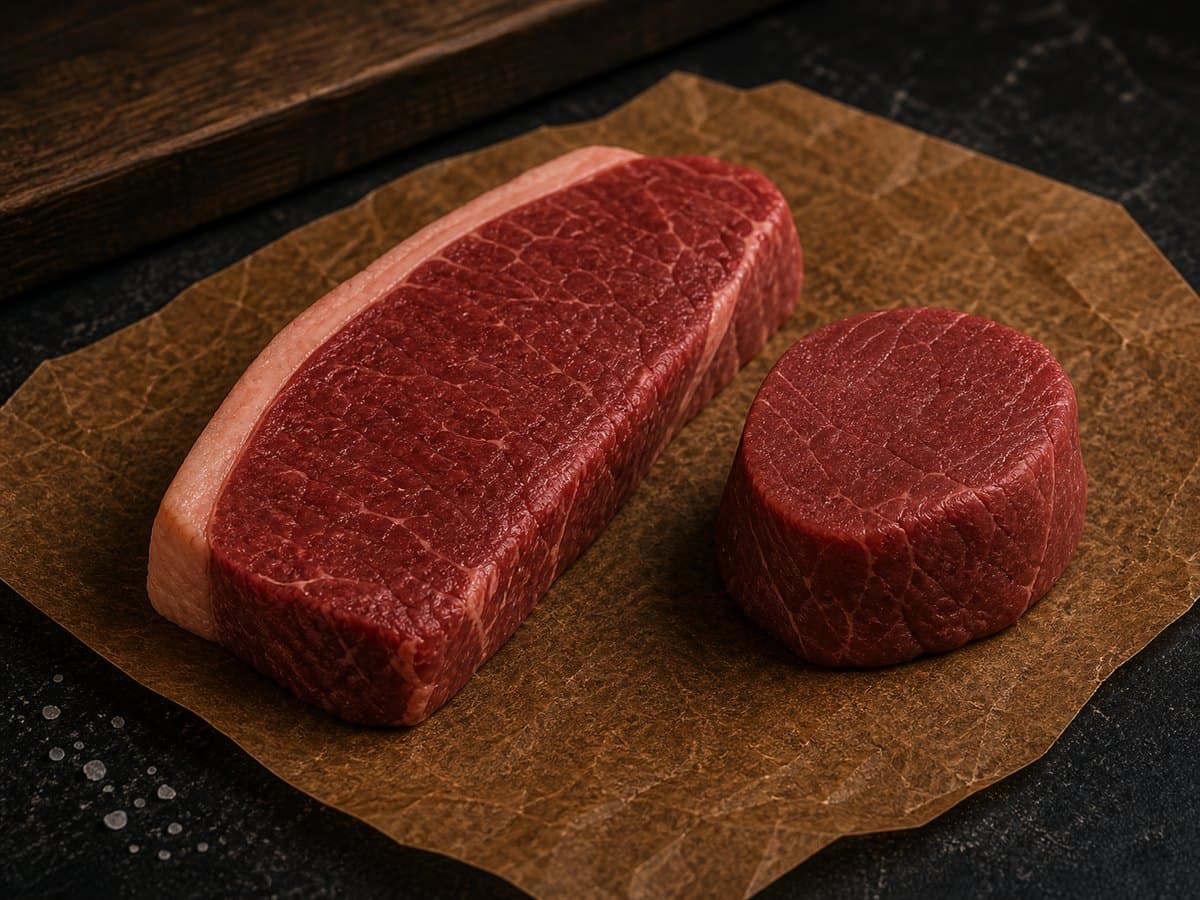
Ribeye is the cut for a steak you want to enjoy rather than merely eat. It has a fat cap, an eye of tender muscle and a seam of fat through the middle that renders into everything around it. It is almost impossible to make dry and it does not need a sauce. This is the default answer if someone asks what to buy.
Tenderloin — ours at ₱1,700 Brazilian and ₱2,450 USDA — is the softest cut on the animal and the least flavourful, which is a trade some people are happy to make and others are not. It has almost no fat, so it goes from perfect to grey very quickly, and it is the one cut that genuinely benefits from a sauce or a compound butter. Buy it for someone who dislikes chew, or for beef Wellington, or for medallions.
Chuck eye is the cook's cut. It comes from the shoulder end, adjacent to the ribeye, and carries much of the same marbling for roughly a third of the price. It is slightly less tender and slightly more work to trim, and if you are happy with that it is the best-value steak in the shop.
Sukiyaki cut is beef shaved thin across the grain, sold in 1kg packs. It is not a steak and should not be treated as one: it exists for hotpot, for stir-fries and for Philly-style sandwiches, and it cooks in under a minute. Ground beef is one of the few things in this shop we make rather than buy: we grind it here from two different cuts — chuck eye for the everyday version, ribeye for the one that makes a noticeably better burger — in 250g, 500g and 1kg packs. The beef burgers, the lamb burgers and the köfte are ours too, made from the same meat rather than from trimmings.
How to cook a steak that is worth what you paid
Take the steak out of the fridge thirty to sixty minutes before it meets heat. A cold centre means the outside overcooks while the middle catches up. Dry the surface thoroughly with paper — water is the enemy of a crust, because the pan spends its energy boiling it off instead of browning the meat.
Salt generously, and either right before cooking or a full hour before. The window in between is the worst of both worlds: the salt has drawn moisture to the surface but has not yet been reabsorbed, so you are searing a wet steak.
Get the pan properly hot — cast iron if you have it — and leave the steak alone. A 2.5cm ribeye wants roughly three minutes a side for medium rare, but thickness matters far more than weight, and the only reliable method is a thermometer: 52 °C for rare, 55 for medium rare, 60 for medium. Pull it three degrees early, because it keeps cooking as it rests.
Rest it. Five minutes for a steak, ten for a thick one, on a warm plate, uncovered or loosely tented. Cutting straight into a steak empties it onto the board. This single step separates most disappointing home steaks from good ones.
For the leaner Brazilian cuts, add a spoon of butter and a crushed garlic clove to the pan in the last minute and spoon it over. Grass-fed beef has less internal fat to baste itself with, and that thirty seconds of basting closes most of the gap.
Bacon, three ways
The bacon comes from a local producer who cures and smokes it properly, and it comes in three: natural, honey, and wood-smoked. Natural is the plainest and the most useful in cooking, where you want bacon flavour rather than sweetness. Honey caramelises hard and fast, which is wonderful in a pan and a nuisance on a barbecue. Wood-smoked is the one to buy if the bacon is the point of the dish rather than a background note.
It is sold in 500g and 1kg packs, with 3kg+ and 5kg+ prices for households and small kitchens that get through it — the per-kilo price drops meaningfully at those sizes. Picnic bacon, at ₱1,300 a kilo, is the cut from the shoulder: meatier, less fatty, and better in stews and carbonara than under a fried egg.
Cook bacon from a cold pan, not a hot one. Starting cold lets the fat render out slowly so the meat crisps in its own fat instead of seizing and curling. It takes a few minutes longer and the difference is not subtle. For the oven, 200 °C on a rack for fifteen to twenty minutes gives the flattest, most even result, which matters if you are cooking for a table.
Lamb, ostrich and the rest of the case
Lamb shanks at ₱1,500 a kilo are a braise and nothing else — three hours at 150 °C with wine, stock, garlic and rosemary, until the meat retreats from the bone. They are the single most forgiving thing in this category: there is no version of a shank that is overcooked, only ones that are not yet done. Lamb burgers come as a 2-pack and want a hotter, faster cook than beef, with mint or cumin rather than cheese.
Ostrich is new to the counter and genuinely worth trying. It is a red meat despite being a bird — deep red, very lean, iron-rich, closer to venison than to chicken in both taste and behaviour. Because it carries almost no fat it must be cooked rare to medium rare and rested properly; past medium it turns dry and there is no recovering it. Sear the steaks hard for two minutes a side and stop. The ground ostrich in 1kg packs makes a lean, dense burger and an excellent ragù, and is worth mixing with a little pork or beef fat if you want a juicier patty.
Beef and lamb kofta at ₱1,350 a kilo is already seasoned and shaped for the grill. Australian veal liver, at ₱1,000, is milder and finer than beef liver and cooks in ninety seconds a side — any longer and it goes grainy.
How much to buy, and how to store it
For steak as a main course, count 250 to 300 grams per adult on the bone or 200 to 250 grams off it. For a mixed grill, 150 grams of each meat per person. Ground beef for burgers wants 150 to 180 grams per patty — less than that and it cooks through before it browns.
Fresh beef keeps three to five days in the coldest part of the fridge and benefits from being unwrapped and set on a rack on a plate, uncovered, for the last day or two. That is dry ageing in miniature: the surface dries, the crust improves, and nothing is lost but a little water.
For the freezer, wrap tightly and use within six months for steaks, three for ground. Thaw in the fridge over a full day — a thick steak thawed in water or a microwave loses far more juice than one thawed slowly, and you paid for that juice.
Everything here is cut to order. If you want a thicker steak than the ones in the case, or a specific weight, say so — that is what a counter is for. Message ahead on WhatsApp and we will have it ready.