Cooked, cured, smoked: three different things
The words on a deli counter are used loosely everywhere, so it is worth being precise. A cooked ham is brined and then cooked through with heat — our cooked ham, honey ham, forest ham and farmers ham are all in this family. They are moist, mild, sliceable, and ready to eat.
A cured product is preserved with salt and time rather than heat. Salami is the clearest example: ground meat and fat, salt, spice, fermented and then dried for weeks until it has lost a third of its weight. Nothing is cooked. The safety comes from salt, acidity and water activity, which is why a whole salami keeps in a cupboard while a cooked ham does not.
Smoking can be applied to either, and does two things: it adds flavour compounds, and it dries and preserves the surface. Our wood-smoked ham is cooked and then smoked; the flavour is assertive enough to stand up in a hot dish as well as cold on bread.
Knowing which is which tells you how to store it and how long you have. Cooked hams and sliced cold cuts are perishable and want three to five days. Whole dried sausage and salami are stable far longer, and the only thing that happens with time is that they get drier and more concentrated.
The German and Swiss counter
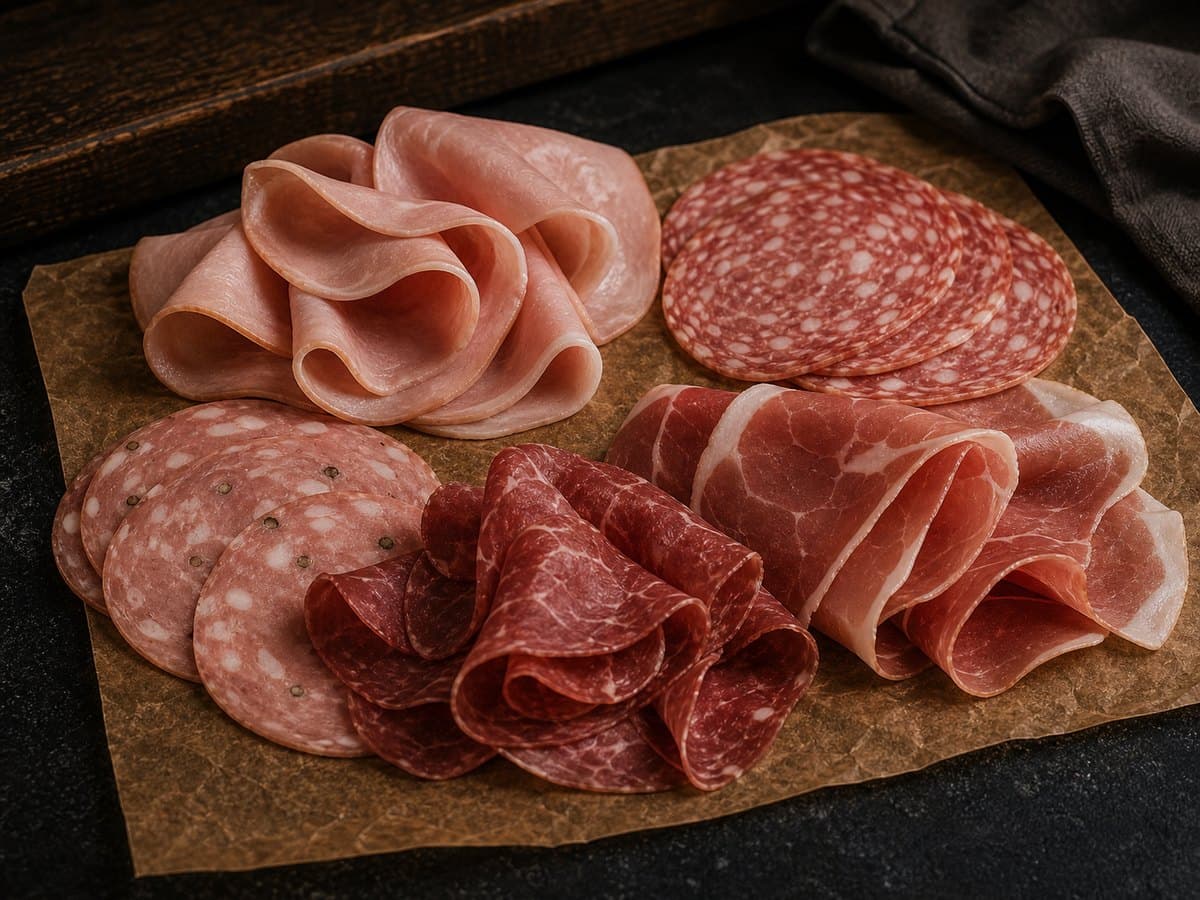
Lyoner is the smooth, pale, fine-textured sausage that most Germans grew up with in slices — mild, springy, and the least challenging thing on this counter. Pepperoni lyoner is the same base shot through with peppers, which gives it heat and colour without changing the texture.
Mortadella is the Italian relative: a very fine emulsion studded with cubes of fat, and often pistachio. It is the one to buy if you want a cold cut that tastes luxurious rather than merely convenient, and it is at its best sliced almost transparently thin so the fat melts on contact.
Florentiner and the Polish beef cold cut sit in the middle ground — coarser, more assertive, closer to what you would put on a board with mustard and a pickle than into a child's lunchbox.
Meat loaf, sold sliced, is Fleischkäse, and it is the one item here that is better hot than cold. Cut it thick — a full centimetre — and fry it until the edges catch and blister. With a fried egg and sweet mustard, that is a meal rather than a sandwich.
Hams, and why we sell them two ways
Honey, forest and farmers ham are all sold as 200g packs, which is the size that makes sense for a household getting through a few sandwiches a week: the ham is sliced, sealed, and has not been sitting open. Honey ham is the sweetest and the most popular with children, forest ham is smokier and drier, farmers ham is the plainest and the most useful in cooking.
Cooked ham, chicken ham and turkey ham are cut by the kilo at the counter. Turkey ham is the leanest of the three and the one to ask for if you are avoiding pork; chicken ham is milder still. Beef pastrami — brined, spiced with coriander and pepper, smoked — is the most strongly flavoured item in the case and needs nothing but rye bread and mustard.
Wood-smoked ham comes in 1kg, 3kg+ and 5kg+ formats with the price stepping down as the size goes up. That is deliberate: a household buys a kilo, a small restaurant or a villa kitchen buys five, and there is no good reason for the second to pay the first one's price.
Thickness matters more than people think
How a cold cut is sliced changes how it tastes, and it is worth telling us what you want rather than accepting a default. Thin — almost translucent — suits the fatty, finely textured products: mortadella, lyoner, cooked ham. The slices drape, the fat warms to body temperature almost instantly, and the flavour arrives all at once.
Medium, around 2mm, is the sandwich standard and the right choice for most hams. It holds its shape, does not tear when you lift it, and gives the bite something to work against.
Thick, 5mm and up, turns a cold cut into an ingredient: ham for dicing into a carbonara or an omelette, meat loaf for frying, pastrami for a proper Reuben. Ask for a single thick slab rather than a stack, and cut it at home to whatever the dish needs.
If you are building a board for guests, ask for three or four different things sliced thin and a couple of thicker pieces for contrast. Around 80 to 100 grams of cold cuts per person is generous as a starter; 150 grams if the board is the meal.
Storing sliced meat so it lasts the week
Sliced cold cuts are the most perishable thing in this part of the shop, because slicing multiplies the surface area exposed to air by an enormous factor. Three to five days refrigerated is realistic; beyond that the edges dry, the colour dulls and the flavour flattens.
Keep them in the coldest part of the fridge, which is the back of the lowest shelf — not the door, where the temperature swings every time someone reaches for a drink. Keep them sealed, and if the original pack is opened, move the contents into something airtight rather than folding the plastic over.
Cold cuts freeze better than their reputation suggests, particularly the cooked hams. Separate the slices with baking paper before freezing so you can take out three rather than the whole block, and use within two months. Salami and the dried products do not need freezing at all — a cool cupboard or the fridge, loosely wrapped in paper rather than plastic so they can keep breathing.
If a slice has gone slippery or smells sour rather than simply meaty, throw it out. That is the one category where a cautious nose is worth more than an optimistic one.
Buying at the counter
Most of this case is cut to order and priced by the kilo, from ₱800 for lyoner to ₱1,100 for turkey ham. Ordering 150 grams of one thing and 200 of another is entirely normal — this is a counter, not a shelf, and small mixed orders are what it is for.
The 200g ham packs exist for convenience and are the better buy if you want one thing, sealed, for the week. The by-the-kilo hams are better if you are feeding a household or want a specific thickness.
Stock on this counter changes as things are cut and finished, so the list on this page — which reads from the till — is the accurate picture rather than a menu. If you want something specific for a particular day, a WhatsApp message the day before means it will be there.